Sony and Warner Just Put Claude's Lyrics on the Docket
Yesterday OpenAI pulled the Cursor contract. Overnight the access story sat still. The copyright docket did not.
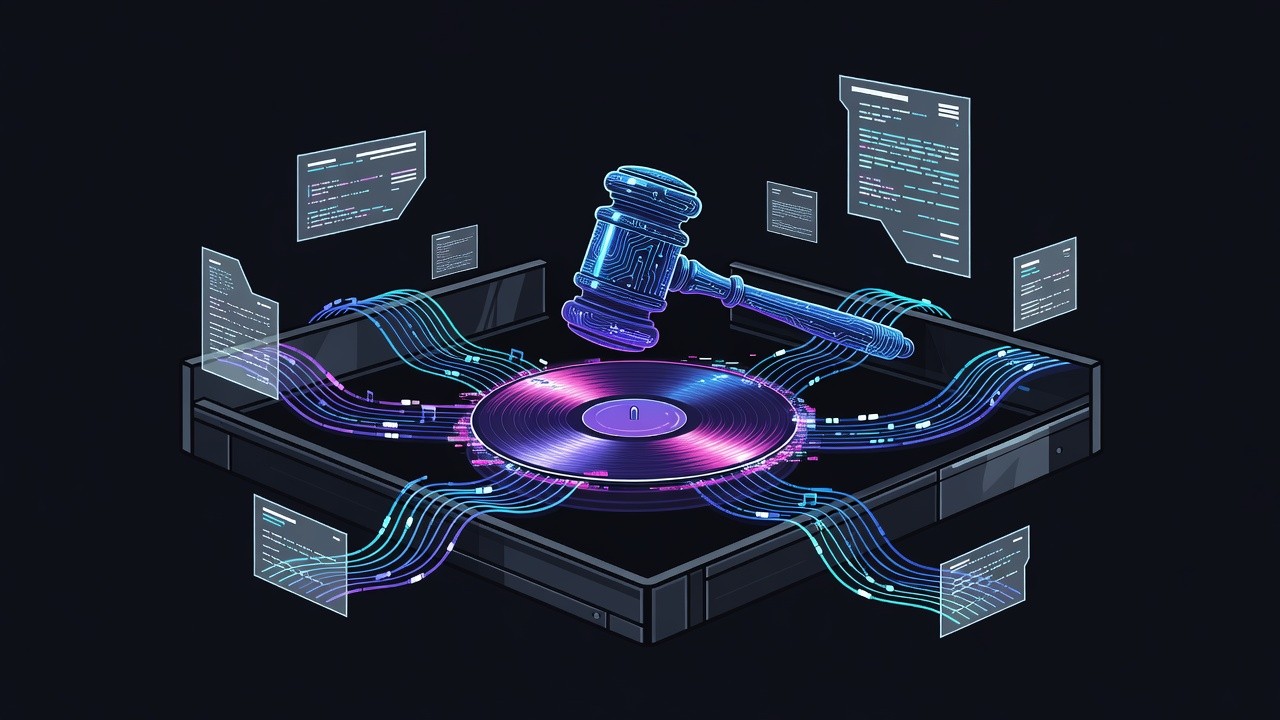
Sony Music Publishing and Warner Chappell sued Anthropic late Friday in the Northern District of California, and they named Dario Amodei and Benjamin Mann personally. The complaint calls it a “brazen campaign of illegally torrenting, scraping, and downloading copyrighted works.” Anthropic’s line to TechCrunch: we disagree, and we will defend ourselves in court.
This is not a new theory of training. It is a new plaintiff stack on the same piracy fact pattern that already cost Anthropic 1.5 billion in the Bartz authors’ settlement. A judge there said training on copyrighted books can be fair use. Acquiring the books by torrenting them is not. Sony and Warner are walking that distinction into lyrics and sheet music.
The complaint is the Bartz play, with a music catalog
The Verge has the numbers the publishers want a jury to see. Tens of thousands of compositions. Statutory damages of up to 150,000 dollars per work, plus up to 25,000 for each time copyright-management information was stripped. That math is how a “lyrics case” becomes a multi-billion headline before anyone sings a note in court.
The alleged pipeline is specific. Mann is accused of using BitTorrent to pull over five million pirated books. Employees allegedly downloaded at least two million more from Pirate Library Mirror. Those are the same archives that sat under Bartz. The music angle is that a lot of those books contain lyrics and sheet music, and that Anthropic also scraped licensed lyric sites like MusixMatch and LyricFind. Named titles in coverage include Marvin Gaye and Tammi Terrell’s “Ain’t No Mountain High Enough,” Bon Jovi’s “Livin’ On a Prayer,” Earth, Wind & Fire’s “September,” Leonard Cohen’s “Hallelujah,” and Taylor Swift’s “Paper Rings.”
Sony and Warner are not first in line. Universal, Concord, and ABKCO already sued. So did BMG and Round Hill. What is new is the breadth and the founders as defendants. If you run a lab, the lesson is not “never train on music.” It is that how you acquired the corpus is now the live issue, and the people who clicked download can be named.
A quiet pair of studio headphones still costs less than a discovery fight over whether Claude memorized “September.”
a16z just funded the wall the models hit
While the lawyers filed, Andreessen Horowitz closed a 1.1 billion Machine Age Fund to buy the physical stack. Chips, memory, networking, storage, data centers, robotics, even home AI appliances. Ben Horowitz, Martin Casado, Raghu Raghuram, David Ulevitch, and David George signed the post. The pitch is that software already ate the world, and the leftover problem is racks, copper, and megawatts.
The numbers they put on the page are the ones that matter if you actually provision:
| Layer | What they say is breaking |
|---|---|
| Rack density | 28x from an H100 rack to a Rubin rack |
| In-rack networking | Hitting the limits of copper |
| Rack power | 5–10 kW then, 100–250 kW now, 1 MW in about three years |
| Campus scale | Tens of MW to hundreds of MW, some GW sites |
| Supply | Hardware vendors grew 20–30% a year; demand wants triple digits |
Hardware is now over 20% of a16z deal flow. That is not a vibe shift. That is a firm that used to write software checks watching founders stall on memory, interconnect, cooling, and behind-the-meter power. TechCrunch has the short version; the a16z post is the primary.
If you are buying the local side of that wall, a used workstation and 256GB of RAM still beat waiting for someone else’s GW campus to get a permit.
Claude Code’s “raise” is a 17 percent cut from what you have today
Same weekend, Anthropic told developers the 50% Claude Code weekly-limit promo is not the new normal. Starting September 14, standard weekly limits go up 25% permanently for Pro, Max, Team, and seat-based Enterprise. The current 50% bump stays until then. Compared with today, that is about a 17% cut.
The arithmetic is not subtle:
| Baseline | Weekly allowance |
|---|---|
| Old standard | 100% |
| Current promo | 150% |
| Permanent from Sept 14 | 125% |
| Vs what you have now | about 17% less |
Anthropic has not published token numbers. Usage still depends on model, conversation length, tools, and effort. Five-hour session caps are unchanged. Extra usage credits remain the overflow valve. The company says it sized the permanent number to what it can sustain, and it teased more visibility and control later. The Help Center article for the old promo still lists an August 31 end date; the September 14 schedule is coming from ClaudeDevs. Trust the dashboard, not the blog post from May.
If you are going to lose a sixth of the weekly bucket in two weeks, a fast 4TB NVMe for a local fallback is a cheaper insurance policy than another Max seat you will still hit.
The book settlement did not close the corpus question. It taught plaintiffs where to aim: the torrent, not the transformer. Music publishers just filed on that map, with founders on the caption. Across town, a 1.1 billion hardware fund is betting the next bottleneck is power and copper, not another chat UI. And the coding agent a lot of this site’s readers actually pay for is about to give back part of a summer promo. If you ship on Claude, log the September 14 date. If you train on other people’s catalogs, log how you got the files.
Want this in your inbox every morning? Subscribe to the SpaghettiStories newsletter.
Some links may be affiliate links. If you’re buying hardware to run local models, this affiliate link helps keep the lights on.