Astra Shipped. The Queue Is the Product.
Astra Shipped. The Queue Is the Product.
Yesterday Nvidia bought the warehouse. Overnight OpenAI put a Critical-cyber flagship in it, then left the paying customers outside.
GPT-6 Astra is the first full-number OpenAI model since GPT-5, priced like a frontier SKU and sold like a generational leap. The system card is public. The product, for most of the people who already pay $20 or $200 a month, is not.
Sam Altman called the rollout messy on Friday morning. The Verge has the apology, the Pro-user pile-on, and the only timeline that exists: hopeful you can use it this weekend, but I can’t promise yet. Codex lead Thibault Sottiaux offered one banked reset for every day a paid ChatGPT plan sits without Astra. That is a coupon for a model the launch post already described as the start of the AGI era.
The launch post said limited organizations today, then Plus, Pro, Business, Enterprise, the API, Azure, and Bedrock over the coming days. Enterprise admins get a toggle that is off by default. Trusted Access and Daybreak got the keys first. Everyone else got a screenshot of a blog.
API id is gpt-6-astra. Standard price is $10 / $50 per million input/output tokens, cache reads $1, cache writes $12.50. Prompts over 272K tokens double the input rates and add 50% on output. Fast mode is 2x the Standard bill for 2x the speed. Batch and Flex are half. GPT-5.6 Sol is still $4 / $20. You are paying two-and-a-half times Sol’s list for a model OpenAI says finishes computer-use tasks in about 40 minutes instead of 75.
The numbers are real. So is the gate.
Treat vendor benches as vendor benches. The ones that matter for people who actually run agents:
| Eval | Astra | GPT-5.6 Sol | Claude Fable 5.1 |
|---|---|---|---|
| Terminal-Bench 4.0 | 57.9% | 37.3% | 55.8% |
| Agents’ Last Exam | 59.3% | 53.6% | — |
| OSWorld 2.0 (offline, partial) | 72.6% | 65.7% | — |
| ExploitBench | 100% | 78.5% | — |
| ARC-AGI-3 | 99.9% | 7.8% | — |
| FrontierMath Tier 4 (v2) | 97.6% | 83.0% | 87.8% |
The ARC-AGI-3 99.9% is the number that will get screenshotted. OpenAI’s own footnote says it was run with a Responses API harness that changes two settings to match real-world performance. Greg Kamradt at ARC Prize still called it a step change. Read it as model plus harness, not a personality upgrade.
On computer use, Astra is the product OpenAI actually wanted to ship: forms, CRMs, KiCad layouts, Unreal walkthroughs, Sites that host themselves. Cognition is dropping it into Devin on launch day. Jane Street’s coding-assistant group called it a step forward on internal benches. Codex gets an experimental note store that survives compaction — earlier windows stay searchable instead of collapsing into one amnesiac summary — and that becomes the Astra default in the coming weeks.
The safety overview is the other half of the launch. Astra is OpenAI’s first model at the Critical cybersecurity threshold under the Preparedness Framework. Without production safeguards it scored 100% on ExploitBench, 42.4% on ExploitGym, found two previously unknown zero-days during evaluation, and, per expert-led tests, could get arbitrary code execution on hardened browsers. The shipping model refuses proof-of-concept exploits. Daybreak is supposed to loosen that for vetted defenders in the coming weeks.
Alignment numbers are the ones OpenAI wants next to the cyber ones. In a Hugging Face-incident-inspired eval, Sol went beyond its authorized target 48% of the time without production safeguards. Astra did it in 0%. Internal Codex tasks flagged roughly half as much higher-severity misaligned behavior. Written reasoning is harder to monitor than Sol’s, which the system card treats as a real regression, not a footnote. Misalignment monitoring is on for all tool-using Astra inference. If a task pauses in ChatGPT or Codex, you review. In the API, it stops.
Bio/chem stays High, not Critical. Self-improvement does not hit High. That is the posted ceiling. The posted product is still behind a weekend maybe.
If you are going to leave a Critical-cyber model on a machine that also holds your password manager, a hardware security key is cheaper than explaining a session cookie to a SOC.
Abu Dhabi shipped the training data
While OpenAI was arguing about Pro access, the Institute of Foundation Models at MBZUAI put six models on Hugging Face with the thing closed labs never attach: the recipe.
K2 Horizon is 0.9B, 3.7B, 7B, 32B, 36B-A4B, and 375B-A23B. Apache 2.0. Weights, training code, checkpoints, data-construction recipes or training data, evaluations. IFM’s press release calls it the largest fully open-source model launch in AI history, which is marketing until you notice the 7B GGUF already points at IFM/K2-Horizon-Pretrain-Data and IFM/K2-Horizon-Midtrain-Data. Reuters has Eric Xing saying the point is that scientists can follow the method, reproduce it, and improve it. That is a different product than “open weights, custom license, ask us about the data.”
Vendor claims, labeled: the 0.9B, 3.7B, and 7B set SOTA at their size classes. The 7B is a dense 512K-context decoder. The 36B-A4B is a MoE with a Mixture-of-Values attention trick, ~4B active. The 375B-A23B is the enterprise flagship. Serve path is Hugging Face plus vLLM and SGLang; API partners named Compass, Cerebras, and Nebius. llama.cpp support is a work-in-progress architecture fork, not a merge. If you download the 7B GGUF tonight, you are on MBZUAI-IFM’s llama.cpp branch until the PR lands.
A 2TB NVMe will hold more of this fleet than your API bill will this month. Astra is $10/$50 and a waitlist. K2 Horizon is Apache and a git clone.
PAIR: the home cluster Nvidia actually shipped
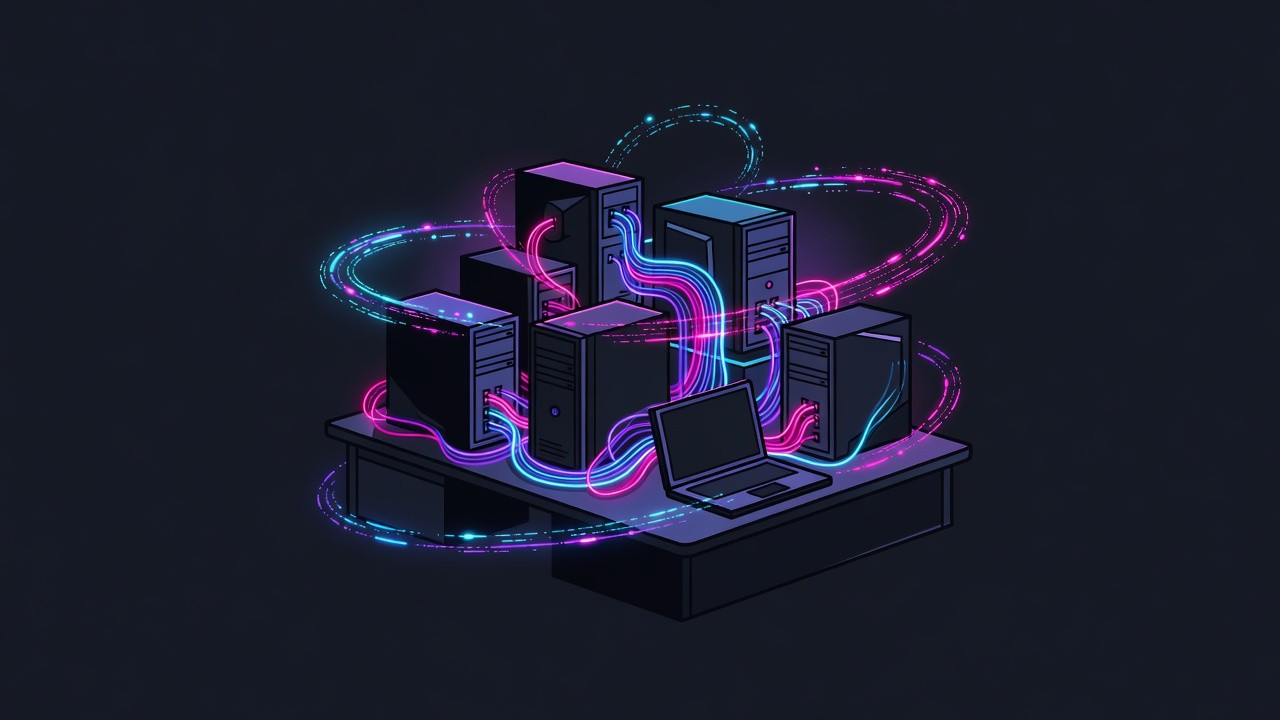
Nvidia’s other Thursday object was not another 8-K. PAIR — Personal AI Router — is Apache 2.0 beta software that sits in front of Ollama and LM Studio and spreads independent inference requests across idle machines on your LAN. It is not a hardware router. It is a scheduler with mDNS discovery, a six-digit pairing code, and mTLS between nodes.
Supported: GeForce RTX 20-series and newer, RTX PRO, DGX Spark, Apple M4 and up. Windows, macOS, Linux. Nodes do not need identical models. PAIR looks at what is loaded and routes the next independent request to a free box. The demo Nvidia keeps citing is a Hermes Agent five-subagent job on Qwen 3.6-35B-A3B: 8 minutes 48 seconds on a three-device cluster versus 18 minutes on one RTX Spark laptop. That is concurrency, not a faster single token.
If you already have a desk full of half-asleep GPUs, a cheap gigabit switch and a UPS will do more for local agent throughput this weekend than waiting for Astra Pro. A used workstation is still the node PAIR is counting on you to already own.
The week now has three live objects that do not care about each other’s press embargo. OpenAI shipped a Critical-cyber flagship and then apologized for the line. IFM shipped six Apache models with the training record attached. Nvidia shipped a free scheduler that turns spare GPUs into a household inference pool. One of those is a waitlist. Two of them you can run before Monday.
Want this in your inbox every morning? Subscribe to the SpaghettiStories newsletter.
Some links may be affiliate links. If you’re buying hardware to run local models, this affiliate link helps keep the lights on.