ByteDance Drops UniVR-34B Planning — Visual Agents Think in Pixel Space
Yesterday we scored GPT-5.6 Sol on the Coding Agent Index and patched Langflow off CISA KEV. The day before that was Ollama capital + Muse Spark. Today the open multimodal lane moved — and it is not another SWE-bench leaderboard tweet.
ByteDance just published UniVR-34B-Planning on Hugging Face. Same news window: NVIDIA’s all-atom pocket docking stack is live, and Gemini 3.5 Pro is still the mid-July countdown everyone is leaving a router seat for.
If you build agents that act in the physical world (or pretend to in simulation), this is the Monday brief.
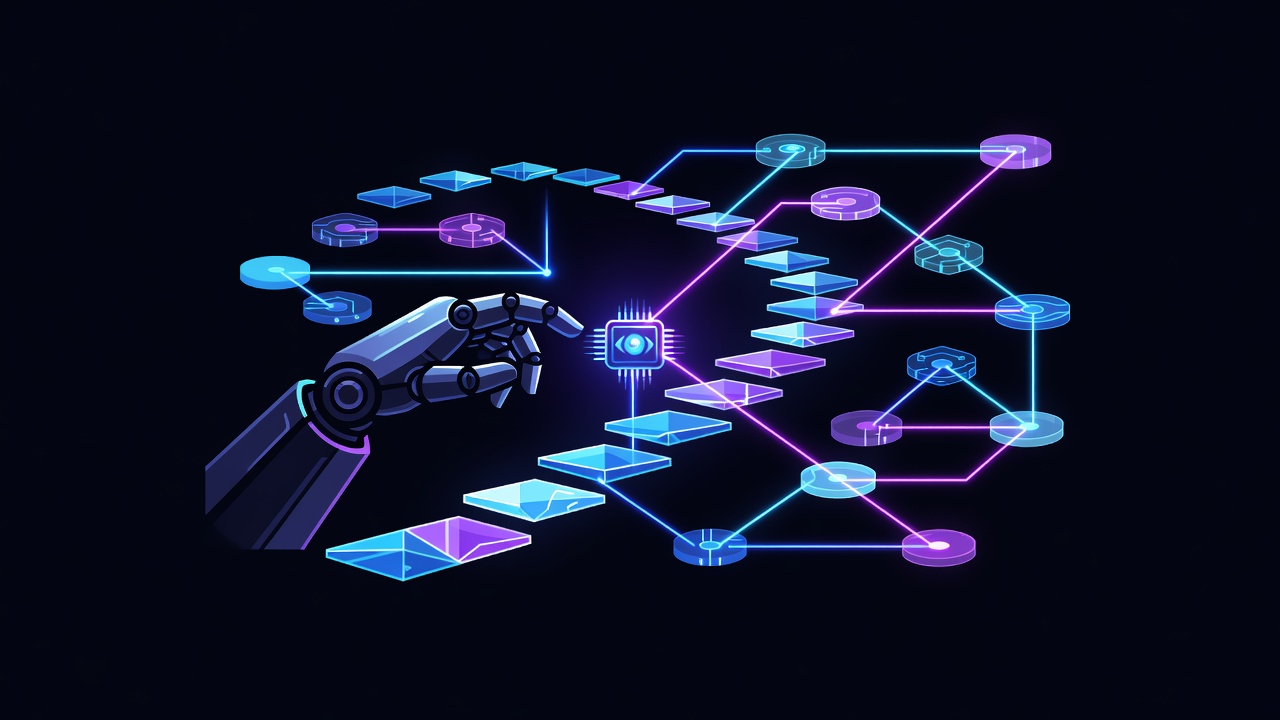
UniVR: reasoning traces in visual space
ByteDance/UniVR-34B-Planning is the planning-specialized checkpoint from UniVR — “Thinking in Visual Space for Unified Visual Reasoning.” The claim is specific:
- Built on Emu3.5 (34B), VQ-VAE unified generative backbone
- Generates visual reasoning traces from an image + instruction via next-token prediction
- No intermediate text chain for the thinking path — native visual-space reasoning
- Two-stage training: SFT cold start (~310k samples) → VR-GRPO RL (~3k samples)
- Optimized for long-horizon planning: robotic manipulation, tool use, multi-step control
- License: CC BY 4.0
There is also a General checkpoint for broader visual reasoning; Planning is the one that matters for agent stacks that need multi-step physical control.
On the VR-X benchmark (16 sources, 6 task categories, ~1.8k eval samples), UniVR claims up to ~25% improvement over the Emu3.5 baseline and approaches a Gemini 3 Pro + image model combo while staying at 34B parameters. Categories cover robot, editing, spatial, puzzle, search, and guidance-style tasks — the stuff text-only coding agents hand-wave as “use a vision tool.”
# High-level path (see model card for full deps)
from transformers import pipeline

pipe = pipeline(
    "image-text-to-text",
    model="ByteDance/UniVR-34B-Planning",
)
# Image + instruction → visual reasoning / plan traces
vLLM / SGLang serve recipes are already on the card. If you already run open multimodal weights on funded local infra from last week’s Ollama story, this is a different job class than Muse Spark chat — it is closer to a planner head for embodied or tool-heavy agents.
Practical read: coding agents got measured cost/perf over the weekend. Embodied and multi-step visual agents just got a planning-focused open checkpoint with RL that tries to punish intermediate physical violations, not just terminal reward. That is the missing middle between “describe the scene” VLMs and “ship the PR” coding harnesses.
VR-GRPO: why the RL recipe matters for agents
UniVR’s training story is not just “more SFT.” VR-GRPO (Visual Reasoning GRPO) combines:
- Global reward (R_g) — VLM evaluator on overall task completion + visual quality
- Step-focal reward (R_s) — finds error-prone sub-steps via inter-trajectory CLIP variance, then scores critical windows
- Combined — enforces both terminal correctness and procedural integrity
That design is aimed at a real agent failure mode: global-only rewards that ignore intermediate physical violations and logical gaps. If you have ever watched an agent “succeed” on a rubric while skipping safety or state constraints mid-trajectory, you know why step-focal pressure matters.
Training data is the VR-X corpus (SFT/RL splits on HF as maverickrzw/VR-X-SFT-RL), aggregated from ~1.5M raw samples across robot datasets (AgiBot, Droid, Bridge), egocentric video, cooking/handcraft, navigation, and visual puzzles. For agent builders, that means the planning checkpoint is not a pure internet-caption VLM — it is biased toward demonstrated multi-step control.
Paper / code / project links ride the model card; start at the HF model page and treat third-party tracker pages as secondary.
NVIDIA nvDock: science agents get all-atom pockets
Different vertical, same open-weights muscle memory. nvidia/nvDock (all-atom DiffDock Pocket; HF card lists ~July 10, 2026) is a diffusion docking stack for when the protein binding pocket is already known.
- Score model generates candidate ligand poses inside the pocket via reverse diffusion
- Confidence model ranks poses
- All-atom pocket representation (not just Cα skeletons)
- NVIDIA Open Model Agreement for the weights; Apache/MIT pieces for related code
- Commercial and non-commercial use called out on the card
This is not a coding agent. It is the class of domain tool you wire into a research agent when the tool surface is chemistry, not git. Pair it with the broader NVIDIA open science stream (CWIP-1.0 and friends from earlier July on the trackers) and you get a picture: while Big Tech fights coding-agent defaults in IDEs and Copilot, open scientific agents are quietly getting specialized docking and planning weights.
If your Monday stack is pure SWE, skip it. If you route tools for biotech or materials loops, pin the card next to your UniVR notes.

Gemini 3.5 Pro: still the mid-July seat, not GA
Third-party trackers and recaps still point at a ~July 17 Gemini 3.5 Pro window after the June slip. Google has not dropped a public model card + pricing day that ends the rumor cycle. TechTimes and earlier Business Insider framing still dominate the countdown: quality refinements, limited enterprise preview history, public GA not yet in your API console as a settled product story.
Do not re-architect routers on rumor dates. Do keep a Gemini seat in the eval matrix so Vertex/API ID flips do not catch you flat-footed — especially if UniVR’s “approaches Gemini 3 Pro + image model” framing is part of why you care about multimodal planning this week.
DeepSeek timing chatter remains in the same calendar neighborhood; same rule applies.
What not to rehash
Launch week (Sol / Terra / Luna / Grok 4.5) is scored. Capital week (Ollama) is funded. Security weekend (Langflow KEV, EDR false positives) is patched or accepted. Today’s delta is open visual long-horizon planning + science docking + the Gemini clock.
If you still need the coding cost matrix, yesterday’s Sol Coding Agent Index post is the table. If you need local escape hatches, the Ollama + Muse Spark post is the floor.
Stack notes for Monday
- Pull UniVR-34B-Planning if you own any robotics / tool-use / multi-step visual loop. Treat it as a planning specialist, not a general chat VLM. Check the General checkpoint only if you need broader visual reasoning.
- Budget GPU honestly. 34B multimodal generative models are not laptop toys. A used NVIDIA A6000 / 6000 Ada or multi-GPU node still beats surprise cloud egress when you iterate on plans.
- Science stacks: evaluate nvDock as a tool endpoint, not as a chat model. Score poses, rank confidence, keep humans in the loop for wet-lab spend.
- Router hygiene: Sol / Terra / Luna / Fable / Grok 4.5 / Muse for code; UniVR-class weights for visual plans; leave a Gemini 3.5 Pro slot empty-but-ready.
- Security still applies. Visual agent platforms that store API keys in flow JSON are the same class of risk as last week’s Langflow story. Rotate keys; lock network paths.
Useful desk kit if you dual-run cloud coding agents next to local multimodal planners: a solid USB-C docking station for multi-laptop farms, a mechanical keyboard that survives overnight harness runs, and enough external NVMe storage that 34B checkpoints do not eat your OS disk.
The frontier coding war is about who owns the IDE default. The open multimodal war is about who owns plan traces that look like the world, not like English. UniVR just put a Planning checkpoint on the table. Score it before Gemini’s calendar alarm goes off.
Affiliate disclosure: Amazon links above use our Associates tag (spaghettistor-20). We only link tools we would actually buy for agent and local-model work.